
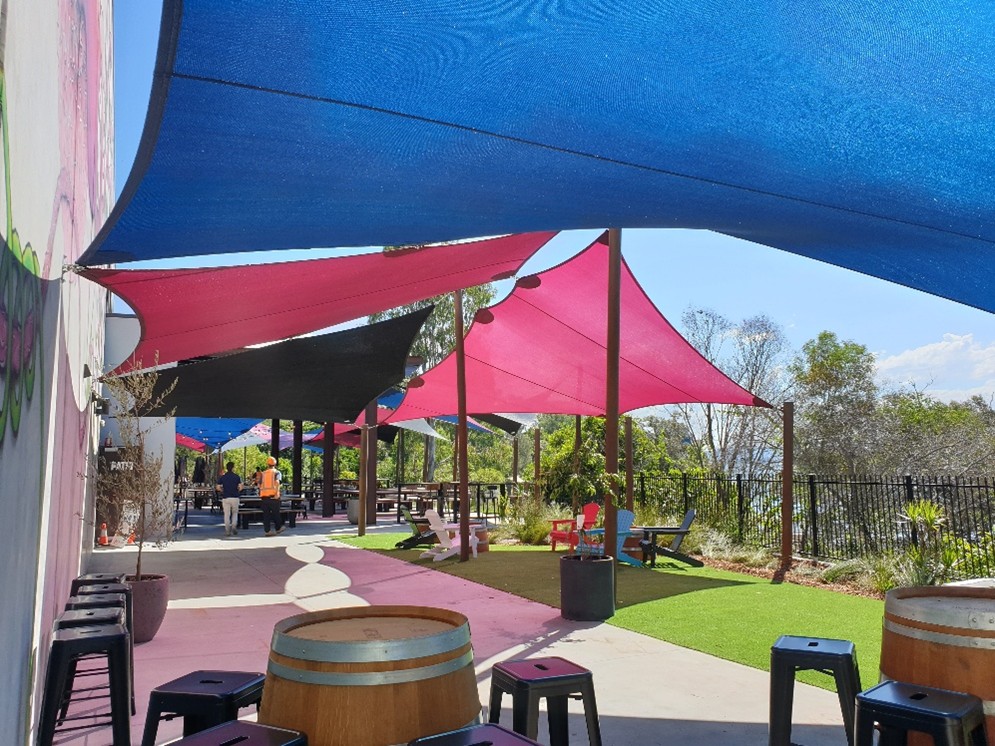
In the rapidly evolving landscape of Australian urban design, particularly within the bustling corridors of South East Queensland, a silent crisis is emerging. As Brisbane and the Gold Coast densify, our architectural palette has leaned heavily toward “Industrial Chic”—a stunning aesthetic defined by exposed concrete, expansive glass facades, and polished steel. While visually striking, this trend has created an unintended side effect: the “Echo Chamber” effect.
From bustling school courtyards to high-end alfresco dining precincts, the modern urban environment is getting louder. Hard surfaces reflect sound waves rather than absorbing them, leading to “noise fatigue”—a psychological state of overstimulation that reduces dwell time in retail spaces and hinders concentration in educational settings.
However, a solution is emerging from an unexpected place. Tensile architecture, long celebrated for its ability to provide shade and iconic silhouettes, is now being reimagined as a powerful tool for acoustic management. By creating “Acoustic Oases,” Versatile Structures is helping developers and designers quiet the urban din using advanced membrane technology.
The Science of the “Soft Ceiling”
To understand how tensile structures quiet a space, we must first understand how sound behaves. When sound waves hit a hard surface like concrete or glass, they bounce back with almost equal energy, creating reverberation. In a crowded restaurant or a school hub, these reflected sounds stack on top of one another, forcing people to speak louder to be heard—a phenomenon known as the Lombard Effect.
Tensile membranes, such as PTFE (Polytetrafluoroethylene), PVC polyesters, and specialized acoustic meshes, operate differently. Unlike rigid roofing materials, these membranes are “active” surfaces. When sound waves strike a tensioned fabric, the material vibrates slightly, converting a portion of the sound energy into trace amounts of heat through friction. This process, known as absorption, significantly reduces the amount of noise reflected back into the environment.
Furthermore, the organic, curved geometries typical of tensile design—the hyperbolic paraboloids and conic shapes—serve to diffuse sound. Rather than reflecting a concentrated “beam” of noise back at the occupants, the curves scatter the sound waves in multiple directions, breaking up the echo and creating a much softer, more “natural” acoustic environment.
Transforming Education: The Quiet Campus
Perhaps nowhere is the need for an Acoustic Oasis more pressing than in our schools. Modern pedagogy has shifted toward open-plan learning and outdoor “breakout” spaces. However, when 200 students gather under a traditional metal-roofed COLA (Covered Outdoor Learning Area), the noise levels can become deafening.
Research has shown that high ambient noise levels in schools lead to increased teacher vocal strain and decreased information retention for students. By replacing or augmenting traditional structures with acoustic tensile membranes, schools can transform a chaotic assembly area into a functional outdoor classroom.
A PTFE-lined structure doesn’t just block the rain; it lowers the decibel ceiling. It allows a teacher to speak at a normal volume and be heard clearly, creating a sanctuary where the architecture itself facilitates learning rather than hindering it.
Hospitality and the “Dwell Time” Connection
In the commercial sector, acoustics are directly tied to the bottom line. For a restaurant or a shopping precinct, the goal is “dwell time”—the longer a customer stays, the more they spend.
If a trendy rooftop bar is so loud that patrons cannot hold a conversation without shouting, they will likely finish one drink and leave. This is “noise fatigue” in action. By incorporating tensile “sails” or integrated membrane ceilings, hospitality venues can “tune” their environment.
Specialized acoustic meshes can be engineered with specific porosity levels to allow airflow while trapping mid-to-high frequency sounds. The result is an atmosphere that feels vibrant but not chaotic. It’s the difference between a space that feels crowded and a space that feels “alive.” In the competitive Brisbane hospitality market, the Acoustic Oasis is becoming a key differentiator for premium venues.
Designing for Wellness: The Psychological Impact
Beyond the mechanics of sound absorption lies the concept of Psychoacoustics—how the sounds around us affect our mental state. Constant exposure to the “harsh” sounds of traffic, construction, and mechanical humming triggers a mild stress response in the human nervous system.
Tensile architecture offers a “biophilic” approach to acoustics. The soft, diffused light filtered through a translucent membrane, combined with the dampened sound profile, mimics the feeling of being under a forest canopy rather than inside a concrete box.
For public retail spaces and healthcare facilities, creating these pockets of quiet is a form of “Wellness Architecture.” It provides urban dwellers with a place to decompress. By strategically placing tensile structures in high-traffic zones, urban planners can create “buffer zones” that protect the human ear and mind from the surrounding city.
The Technical Edge: Materials of the Future
Not all fabrics are created equal when it comes to acoustics. The choice of material is critical to the success of an Acoustic Oasis:
- PTFE Membranes: Known for their longevity and self-cleaning properties, PTFE also offers excellent acoustic dampening. Its microscopic pores allow for sound dissipation that far exceeds metal or glass.
- Acoustic Liners: For projects requiring extreme noise control, a “twin-skin” system can be used. This involves a primary structural membrane with a secondary, specialized acoustic liner underneath, creating a dead-air space that acts as a massive sound absorber.
- Mesh Composites: High-tenacity polyester meshes allow for natural ventilation while breaking up sound waves, making them ideal for breezy coastal environments like the Gold Coast.
The Versatile Structures Approach
At Versatile Structures, we believe that architecture should be felt, not just seen. When we approach a project—whether it’s a bespoke landmark for a council or a functional shade solution for a commercial developer—we don’t just look at the sun path and the wind loads. We look at the “Soundscape.”
Our engineering team works to identify the acoustic pain points of a site. Is the wind whistling through a corridor? Is the traffic noise from a nearby main road bouncing off the building’s glass face? By selecting the right tension, the right geometry, and the right membrane, we turn a simple shade structure into a sophisticated acoustic tool.
Conclusion: The Future is Quiet
As Brisbane prepares for the world stage in 2032, our built environment will be under more scrutiny than ever. The winners in the next decade of architectural development will be those who prioritize the human experience—and that experience is as much auditory as it is visual.
The “Acoustic Oasis” represents a shift in how we think about our cities. It is a move away from the hard, the loud, and the reflective, toward the soft, the quiet, and the resilient. Tensile architecture is the vehicle for this transformation, providing the lightness of touch required to quiet the urban echo and create spaces where people truly want to linger.
If you are designing a space that feels a little too “loud,” it might be time to look beyond traditional building materials. It might be time to find your oasis.