
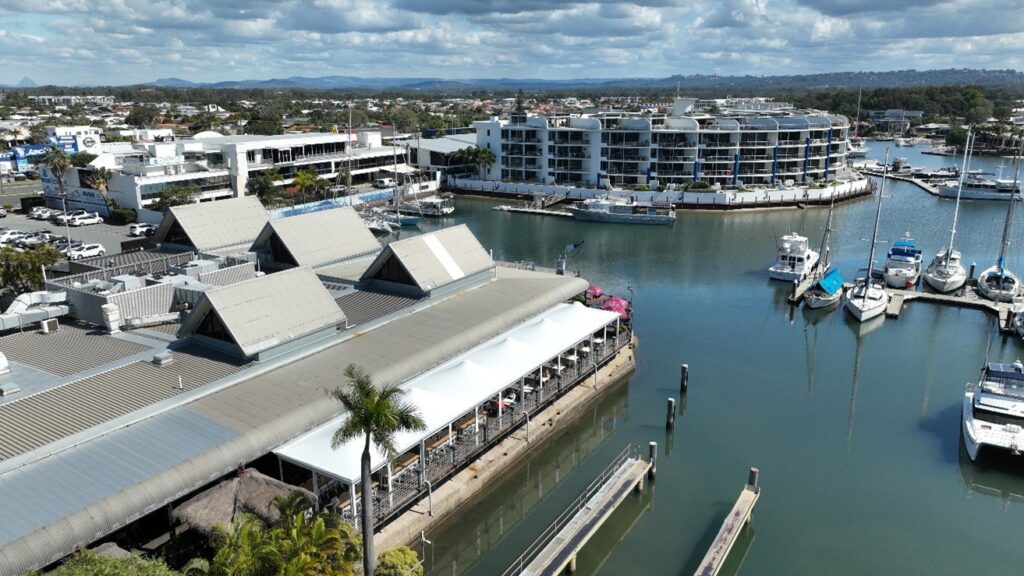
As Australia’s metropolitan hubs—from the sprawling corridors of Southeast Queensland to the dense centres of Sydney and Melbourne—continue to expand, they face an invisible but intensifying threat: the Urban Heat Island (UHI) effect. This phenomenon, where built environments trap heat and remain significantly warmer than surrounding rural areas, is no longer just an environmental talking point; it is a primary challenge for modern architecture and urban planning.
The solution lies in a shift toward Biophilic Shade. By merging advanced tensile membrane design with nature-inspired cooling strategies, architects and developers can move beyond simple sun protection. We are now seeing the evolution of “cool-roof” infrastructure—bespoke structures that don’t just block the sun but actively manage the micro-climate of the spaces beneath them.
Understanding the Urban Heat Island Crisis
The UHI effect is driven by “grey infrastructure”—bitumen, concrete, and dark roofing materials that absorb short-wave solar radiation and re-emit it as long-wave heat. In a city like Brisbane, this can result in localized temperature differences of up to 10°C compared to shaded, vegetated areas.
For commercial developers and local councils, this heat is a liability. It discourages pedestrian foot traffic, increases the energy load on air conditioning systems in adjacent buildings, and creates uncomfortable, high-risk environments in public spaces like schools and parks. Traditional “hard” shading, such as metal sheeting, often exacerbates the issue by radiating heat downward or trapping hot air pockets.
The Role of Tensile Membranes in “Cool-Roof” Infrastructure
Tensile membrane structures—utilizing high-performance fabrics like PTFE (Polytetrafluoroethylene) or architectural-grade PVC—offer a sophisticated alternative to traditional materials. Their role in mitigating UHI comes down to three technical factors: Solar Reflectance, Thermal Emissivity, and Airflow Dynamics.
- High Solar Reflectance (Albedo)
Unlike dark asphalt or traditional roofing, specialized architectural membranes are engineered with high Albedo ratings. White or light-coloured membranes can reflect over 70% of solar radiation. By bouncing the sun’s energy back into the atmosphere before it can be absorbed by the ground, these structures prevent the “heat soak” that typically occurs in car parks and plazas.
- High Thermal Emissivity
Reflectance is only half the battle. Thermal emissivity refers to a material’s ability to release the heat it does absorb. Advanced fabrics used in Versatile Structures’ designs have high emissivity, meaning they stay cool to the touch and do not “bake” the air underneath them, a common failure point of metal-roofed gazebos.
- Convection and Airflow Dynamics
The organic, often hyperbolic shapes of tensile structures are not just for aesthetic flair. These forms are designed to facilitate natural convection. Because the edges are often open and the heights varied, hot air is encouraged to rise and escape, replaced by cooler cross-breezes. This “chimney effect” is a cornerstone of biophilic engineering.
Integrating Biophilia: When Fabric Meets Flora
Biophilic design is the practice of connecting people with nature within the built environment. In the context of shade, this involves more than just selecting a green-coloured fabric; it is about creating a “living” canopy.
Hybrid Green Canopies
One of the most exciting trends in Australian urban design is the integration of climbing vegetation with tensile hardware. By using stainless steel cable systems as a secondary “skin” over or under a membrane, architects can encourage the growth of deciduous vines. In summer, the foliage provides extra evaporative cooling; in winter, the leaves drop, allowing natural light to permeate the space.
Evaporative Cooling and Misting Systems
To further mitigate UHI, bespoke shade structures are now being engineered to house integrated misting systems. When fine water droplets are introduced into the high-airflow environment created by a tensile canopy, they undergo rapid evaporation. This process—adiabatic cooling—can drop the ambient temperature under a structure by an additional 5–7°C, creating a true “oasis” in the middle of a concrete jungle.
Designing for Micro-Climates: Material Selection Matters
Not all membranes are created equal when it comes to heat mitigation. The choice of material dictates the performance of the micro-climate:
- PTFE Fiberglass: Known for its self-cleaning properties and extreme longevity, PTFE offers the highest level of solar reflectance. It is the gold standard for large-scale public plazas where long-term thermal performance is non-negotiable.
- Architectural PVC: A more flexible and cost-effective option, high-end PVC can be treated with PVDF topcoats that enhance UV resistance and reflectance.
- ePTFE (Ethylene Tetrafluoroethylene): This transparent or translucent “foil” (often seen in world-class stadiums) allows for high light transmission while being tinted to block infrared heat, making it ideal for spaces where natural light is needed but heat gain must be controlled.
The Economic and Social Case for Biophilic Shade
For the commercial sector, investing in UHI-mitigating shade is a strategic move.
- Public Health and Safety: For schools and local councils, providing “cool” shade is a duty of care. Reducing the risk of heat exhaustion in playgrounds and sports fields is a primary objective of modern governance.
- Energy Efficiency: When a “cool-roof” tensile structure is placed adjacent to a building’s glass facade, it significantly reduces the solar gain on that building. This lowers the cooling load on HVAC systems, leading to measurable energy savings and a lower carbon footprint.
- Retail and Hospitality Dwell Time: People naturally gravitate toward comfortable environments. A shopping precinct or outdoor dining area that feels 5 degrees cooler than the street will see higher foot traffic and longer dwell times, directly impacting the bottom line for tenants.
The Future of Urban Design in Australia
As we look toward 2030, the “Business as Usual” approach to outdoor infrastructure is no longer viable. Australia’s cities require smarter, more resilient solutions. Biophilic shade represents a marriage of high-level structural engineering and environmental science.
At Versatile Structures, we specialize in the design, manufacture, and installation of these complex systems. We don’t just build shade; we engineer environments. By prioritizing thermal performance, airflow, and nature-integrated design, we are helping architects and developers turn the tide against the Urban Heat Island effect, one canopy at a time.
Conclusion
The transition from “protection from the sun” to “active climate mitigation” is the next frontier in architectural shade. By embracing tensile membrane technology and biophilic principles, we can create urban spaces that are not only visually stunning but are also functionally resilient against the heat challenges of the 21st century.