
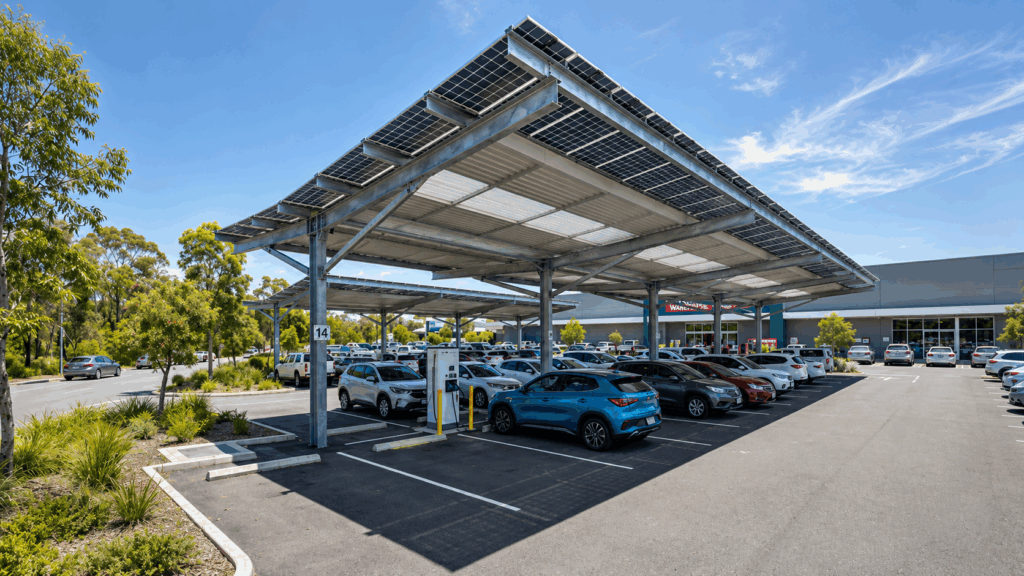
The architectural landscape of 2026 is undergoing a quiet but profound transformation. For decades, commercial shade structures—from sprawling car park canopies to sleek building foyers—were viewed through a singular, functional lens: protection. They were designed to shield assets and people from the blistering Australian sun or the sudden tropical downpours of the Sunshine Coast. However, as energy costs fluctuate and corporate sustainability mandates become more stringent, the role of these structures has shifted.
We have entered the era of Proactive Infrastructure. No longer is a canopy merely a “sun blocker.” In 2026, the most innovative commercial shade solutions are evolving into high-performance power generators. By integrating solar technology directly into architectural membranes and steel frameworks, businesses are turning idle real estate into self-funding assets.
The Death of the “Dead Asset”
Historically, a large-scale commercial car park or a public spectator stand was considered a “dead asset” in terms of energy. It required capital expenditure to build and ongoing maintenance costs to manage, offering only passive utility in return.
The integration of Building-Integrated Photovoltaics (BIPV) has changed that calculus. By utilizing the vast surface area of commercial shade structures, property owners can now capture solar energy without the need for additional land or rooftop space. This is particularly crucial for retail hubs, hospitals, and transit centres where roof space may already be occupied by HVAC systems or where the building’s orientation isn’t optimal for traditional solar panels.
The Technology Powering the Change
The leap from 2024 technology to the solutions we see in 2026 is driven by two primary innovations: flexible architectural membranes and high-efficiency bifacial solar modules.
- Photovoltaic Architectural Membranes: Modern tension membrane structures can now be fabricated with thin-film solar cells embedded directly into the fabric. These materials are lightweight, durable, and flexible, allowing architects to maintain the iconic “sails” and “waves” that define Versatile Structures’ aesthetic while harvesting every kilowatt of available light.
- Bifacial Solar Canopies: For rigid structures, bifacial solar panels have become the industry standard. These panels capture sunlight on both sides—directly from the sun above and via reflected light from the ground below. When paired with light-coloured pavement or reflective surfacing, the energy yield can increase by up to 20% compared to traditional mono-facial setups.
Fuelling the Electric Revolution: The EV Synergy
Perhaps the most compelling argument for solar-integrated shade in 2026 is the explosion of Electric Vehicle (EV) adoption across Australia. With the arrival of high-utility electric utes and luxury SUVs, the demand for accessible, fast-charging infrastructure has reached a tipping point.
A solar-integrated car park canopy creates a closed-loop ecosystem. The energy harvested by the shade structure during the day can be fed directly into on-site EV charging stations. This offers several strategic advantages:
- Reduced Grid Dependency: By generating power at the point of use, businesses can mitigate the high costs of upgrading local grid transformers to handle multiple fast chargers.
- The “Green Halo” Effect: Customers and employees can see the direct link between the shade protecting their vehicle and the energy fuelling it.
- Micro-Grid Resilience: During peak demand or grid instability, solar canopies equipped with battery storage ensure that essential charging services remain operational.
Economic Realities: From Cost to Utility
In the current economic climate, every square metre of a commercial development must justify its existence. Traditional shade is an expense; solar-integrated shade is an investment with a measurable Return on Investment (ROI).
When calculating the feasibility of these projects, savvy developers are no longer looking at the initial “sticker price” in isolation. Instead, they are factoring in:
- Energy Offset: The immediate reduction in operational expenditure (OPEX) by lowering the building’s main power bill.
- LGCs and Government Incentives: Taking advantage of Large-scale Generation Certificates and federal tax incentives for renewable energy infrastructure.
- Asset Appreciation: Buildings with integrated renewable energy sources and high-tech amenities command higher valuations and attract premium tenants.
In many cases, the energy savings generated by a proactive solar canopy can pay for the entire structure’s capital cost within 5 to 7 years, effectively providing “free” shade and power for the remainder of its 20+ year lifespan.
Resilience in the Face of Climate Volatility
2026 has also brought a sharper focus on climate resilience. Australian standards for wind loads and UV degradation are some of the toughest in the world. Proactive shade structures are engineered to meet these challenges head-on.
Using premium materials such as PVC-coated polyester or PTFE-coated glass fibre, these structures offer superior longevity. When integrated with solar, the structural engineering is bolstered to handle the specific weight and wind-lift profiles of the panels, resulting in a canopy that is often more robust than its passive counterparts.
Furthermore, the cooling effect of these structures is twofold. Not only do they provide physical shade, but the solar panels themselves absorb the thermal energy that would otherwise heat the pavement below. This significantly reduces the Urban Heat Island (UHI) effect, creating a more comfortable environment for pedestrians and reducing the cooling load on adjacent buildings.
Designing the Future of Public Spaces
The aesthetic potential of solar-integrated shade is limitless. We are moving away from the “bolted-on” look of early solar experiments. In 2026, the technology is invisible or, better yet, a featured part of the design language.
From sculptural bus shelters that power digital wayfinding displays to stadium concourses that contribute to the venue’s total energy needs, these structures are becoming the “furniture” of our smart cities. They represent a commitment to innovation that resonates with the modern Australian consumer—someone who values high-performance technology as much as they value sustainability.
Conclusion: The Proactive Path Forward
For developers, architects, and business owners, the choice is becoming clear. As we move further into the decade, installing a traditional, passive shade structure will soon be seen as leaving money on the table—and energy in the clouds.
The rise of solar-integrated shade represents a perfect alignment of technology, economics, and environmental necessity. By choosing to be proactive rather than passive, you aren’t just building a canopy; you are building a power plant, a charging hub, and a testament to sustainable architectural excellence.
Versatile Structures remains at the forefront of this transition, combining decades of structural expertise with the latest in solar integration to ensure your next project is ready for the demands of 2026 and beyond.