In the world of commercial shade and tension structures, there is a phrase I hear more often than I’d like: “It can’t be done.”
I’ve sat in boardrooms with council members, developers, and architects who have been told by three different contractors that their site is too restricted, the wind loads are too high, or the underground services are a “no-go” zone.
At Versatile Structures, when someone tells us a site is “impossible,” that’s usually where my interest starts. My name is Jamie Howard, and after 15 years in the steel and membrane industry, I’ve learned that a “difficult site” isn’t a dead end—it’s just a puzzle that hasn’t been solved yet.
Here is the truth about the projects others refuse, and why a “technical first” approach is the only way to turn a high-risk site into an award-winning landmark.
1. The Geometry of the “Un-solvable”
Most people see a shade sail as a bit of fabric and a couple of poles. But when you’re looking at a site like the Logan Village Green, you aren’t just fighting the sun; you’re fighting geometry.
Difficult sites often have “fixed points” that can’t be moved—heritage trees, existing buildings, or tight boundaries. Traditional companies try to force a standard square or triangle into these spaces. When it doesn’t fit, they walk away.
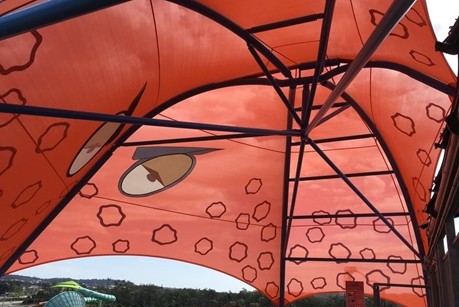
We approach it differently. We use advanced 3D laser scanning and structural modelling to find the “air space” that others miss. By custom-engineering the steel to follow the natural contours of the site—like the organic, leaf-like structures we’ve pioneered—we can provide maximum coverage without ever touching the “no-go” zones.
2. Strength Starts Below Ground (The Invisible Engineering)
The most challenging part of any project is usually the part the public never sees: the footings.
I remember working on a project at the Gold Coast where we were dealing with post-tensioned concrete slabs and a maze of underground utilities. One wrong move with a drill and you’ve shut down a city block. This is where most contractors get nervous.
My philosophy is that strength starts below ground. If the site is “difficult” because of poor soil quality or service density, we don’t just hope for the best. We use non-destructive digging (hydro-vac) and specialized engineering to design shallow-spread footings or weight-distribution plates.
In the case of our Bunnings rollouts, consistency is key, but every site is different. We’ve had to engineer solutions that sit on top of existing structures without compromising the integrity of the building below. It’s about being a “technical specialist” rather than just an installer.
3. Managing the “High-Octane” Environments
A site isn’t just difficult because of its dirt; sometimes it’s difficult because of what’s happening on it.
Take the Queensland Raceway or Tiger Island at Dreamworld. These aren’t standard construction sites. At the Raceway, you’re dealing with extreme wind uplift and high-speed environments. At Australia Zoo, you might be interrupted by a team needing to move a five-meter crocodile (true story—we paused our install to help the keepers carry one of the big guys to his new nest).
When the environment is high-stakes, “good enough” is dangerous. You need a director who understands the logistics of a live site. We’ve built our reputation on being able to work around the public, around animals, and around race cars without missing a beat or a safety check.
4. Why Compliance is Non-Negotiable
On a difficult site, the margin for error is zero. This is why Versatile Structures maintains a 100% success rate on WHS audits.
When you have a site with complex wind loads—like a high-rise rooftop or a coastal park in Noosa—the engineering has to be bulletproof. We don’t guess the tension; we calculate the exact kilonewtons required to ensure that the membrane won’t flap, wear, or fail during a Queensland storm.
We’ve won 5 National Excellence Awards from the Specialised Textiles Association, and I’m convinced it’s because we obsess over the technical details that others find “too hard.” Whether it’s 3D modelling the fall zones for a playground or ensuring a waterproof PVC membrane has the perfect “pre-stress” to prevent water ponding, we lead with the math.
The Jamie Howard Bottom Line
If you’ve been told your site is too small, too busy, or too complex for a high-quality shade structure, don’t settle for a “no.”
A difficult site is an opportunity to do something world-class. It forces us to be more creative with our steelwork, more precise with our membranes, and more innovative with our engineering.
At the end of the day, I’m not just interested in putting up a sail. I’m interested in solving the problem that everyone else walked away from. Because when the project is finally finished—when the “impossible” structure is providing shade to thousands of people at a local park or a major theme park—that’s when we know we’ve done our job.
Ready to see what’s possible on your “difficult” site? Let’s talk about the engineering first.