
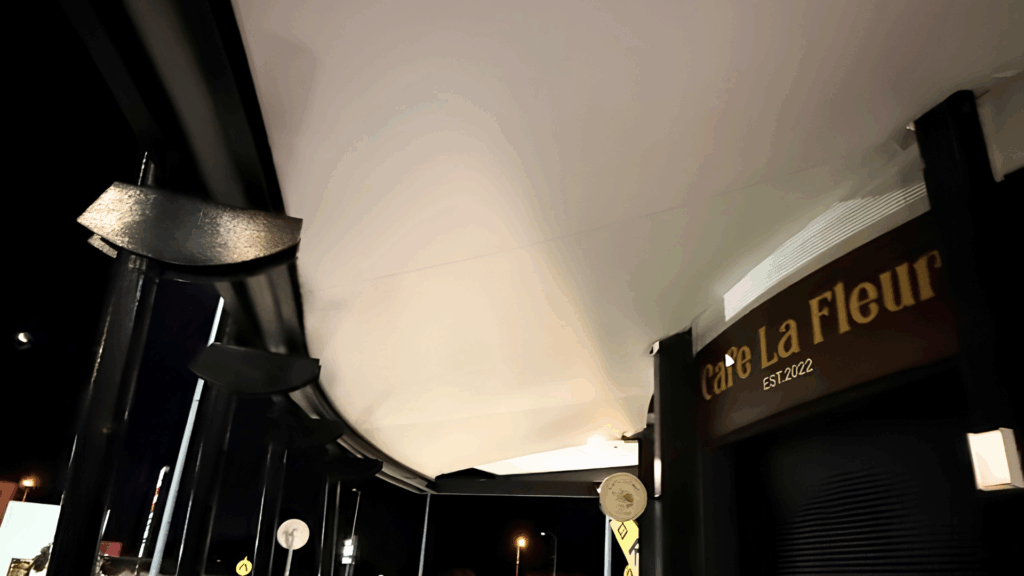
For decades, tensile architecture was viewed through a purely functional lens. It was the “shade sail” over a pool or the canopy protecting a stadium concourse. However, we are currently witnessing a paradigm shift in the AEC (Architecture, Engineering, and Construction) industry. Tensile structures are no longer static, passive elements; they have evolved into “intelligent” architectural systems that act as a functional extension of a building’s skin.
As we push toward more sustainable, responsive, and aesthetically ambitious urban environments, the integration of advanced material science and smart technology is redefining what a “roof” or “facade” can achieve. Here is how intelligent tensile architecture is transforming the modern landscape.
1. Kinetic Membranes: Structures That Breathe
The most significant leap in intelligent design is the move from fixed structures to kinetic systems. Traditionally, architects had to choose a “compromise” position—a structure fixed in a way that offered the best average protection against sun and wind throughout the year.
Modern kinetic tensile architecture removes the need for compromise. Using automated actuators and tensioning systems, membranes can now respond in real-time to environmental stimuli. Sensors measuring wind speed, sun angle, and barometric pressure allow a structure to “furl” during extreme weather events or shift its orientation to maximize solar gain in winter and shade in summer. This adaptability significantly reduces the structural load requirements, allowing for even lighter, more ethereal designs that remain incredibly durable.
2. The Translucency Revolution: Harvesting Natural Light
One of the greatest advantages of materials like ETFE (Ethylene Tetrafluoroethylene) and PTFE (Polytetrafluoroethylene) is their relationship with light. Unlike traditional steel or concrete, these membranes offer high light transmission while filtering out harmful UV rays.
“Intelligent” translucency takes this a step further. By utilizing multi-layered “cushion” systems—most notably seen in projects like the Allianz Arena or the Eden Project—engineers can vary the internal pressure of the cushions to change the insulation properties of the building. Furthermore, by printing “frit” patterns on different layers of the membrane, the transparency of the structure can be adjusted by slightly shifting the alignment of the layers. This allows a building to effectively “dim” its own roof, regulating internal temperatures without the massive energy consumption of traditional HVAC systems.
3. Integrated Technology: The Fabric as a Canvas
The integration of technology directly into the fabric of the structure is perhaps the most visible aspect of this evolution. We are moving beyond hanging lights under a canopy; the canopy itself is becoming the light source.
Media Facades and Embedded LEDs
Advanced membranes can now be manufactured with integrated LED nodes or woven with conductive fibres. This transforms a functional shade structure into a massive, low-energy media facade. During the day, the structure provides essential cooling; at night, it becomes a landmark piece of light art or a communication tool for public spaces. Because the light is diffused through the translucent membrane, it creates a soft, ambient glow that is far more aesthetically pleasing than the harsh glare of traditional floodlighting.
Solar Energy Integration
The next frontier is the “Solar Canopy.” Flexible photovoltaic (PV) cells are now being integrated directly onto the surface of tensile membranes. While traditional solar panels are heavy and require rigid mounting, these thin-film cells move with the fabric. This allows large-scale car park canopies or stadium roofs to act as decentralized power plants, generating renewable energy while providing shade for the assets beneath them.
4. Sustainability and the “Low Carbon” Footprint
In the current climate, intelligence is also measured by environmental impact. Tensile architecture is inherently “lean.” It uses significantly less material than traditional construction to cover the same surface area.
However, the “intelligence” of modern membranes lies in their longevity and recyclability. Premium PVDF-coated PVC and PTFE membranes are now designed for 30+ year lifespans with minimal maintenance. Their high solar reflectance (albedo) helps mitigate the “Urban Heat Island” effect, cooling the surrounding microclimate. When the structure finally reaches its end-of-life, many modern membranes are fully recyclable, feeding back into a circular economy rather than ending up in a landfill.
5. Engineering the Future: The Role of Digital Twins
The “intelligence” of these structures isn’t just in the material; it’s in the design process. Today’s tensile structures are developed using sophisticated “form-finding” software that simulates real-world physics.
Before a single piece of fabric is cut, a “Digital Twin” of the structure is created. This allows engineers to predict exactly how the structure will behave under extreme Australian wind loads or intense UV exposure. This precision engineering ensures that the “intelligent” elements—the sensors, the motors, and the integrated tech—work in perfect harmony with the physical tension of the fabric.
Conclusion: A New Architectural Language
The evolution of intelligent tensile architecture represents a move toward a more “organic” style of building—structures that are lightweight, responsive, and deeply integrated with their environment.
For commercial developers, this means lower operating costs and higher-value landmarks. For public spaces, it means more comfortable, usable environments year-round. For the world of architecture, it represents a new language where the boundary between “building” and “technology” is permanently blurred.
As material science continues to advance, the “Passive Shade” of the past will continue to fade, replaced by the “Active Infrastructure” of the future. The structures of tomorrow won’t just stand there; they will think, react, and provide.