
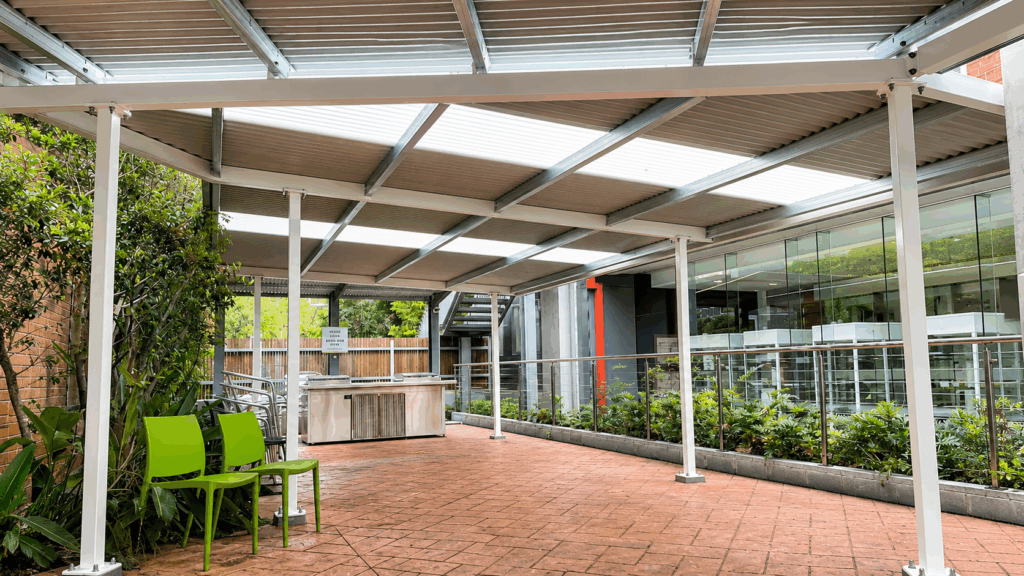
When a commercial developer, school principal, or council planner invests in a large-scale shade structure, the initial conversation almost always revolves around aesthetics. They look at the sleek curves of a hypar sail or the clean lines of a barrel vault and imagine how it will transform a courtyard or a public park.
However, in the harsh environmental conditions of Australia—specifically across Queensland and New South Wales—the “visible” part of the structure is only about 20% of the story. The remaining 80% is the invisible infrastructure: the site-specific engineering, the wind-load calculations, and the subterranean footings that ensure the structure remains a permanent asset rather than a liability during the first major storm.
1. The Geometry of Resistance: Moving Beyond “Off-the-Shelf”
Many off-the-shelf shade solutions fail because they are designed for “average” conditions. In structural engineering, “average” is a dangerous word.
A tensile membrane structure is a dynamic system. Unlike a traditional brick-and-mortar building, a fabric structure relies on pre-stress—the internal tension applied to the fabric during installation. If a structure is under-tensioned, the fabric will “flap” or “pond” during rain, leading to rapid material fatigue. If it is over-tensioned without the correct steel support, it can buckle the very frame it sits on.
The Role of AS/NZS 1170.2 Compliance
In Australia, structural design must adhere to AS/NZS 1170.2, the standard for wind actions. This isn’t just a bureaucratic hurdle; it is a life-safety requirement. Engineering for “Invisible Infrastructure” means calculating:
- Terrain Category: Is the structure in an open field or surrounded by other buildings?
- Topographic Effects: Is it on a hill where wind speeds accelerate?
- Regional Wind Speeds: Designing for a “Region B” (Inland) vs. “Region C” (Cyclonic) requires vastly different steel gauges and connection details.
2. Steel and Stress: The Skeleton of the Structure
The steelwork of a professional shade structure is far more than just “poles.” To achieve a 20-year+ lifespan, the steel must be treated as a precision component.
Connection Architecture
The most common point of failure in a shade structure isn’t the fabric; it’s the connections. High-load structures require custom-machined stainless steel fittings and heavy-duty plates. In “Invisible Infrastructure” design, we look for:
- Articulated Connections: Allowing for slight movement under extreme wind loads to dissipate energy rather than snapping.
- Internal Ribbing: Reinforcing steel columns at the base to prevent “leaning” over a decade of tension.
3. The Foundation: What’s Under the Surface?
If the steel is the skeleton, the footings are the anchor. For a large commercial structure, the “invisible” footings are often as complex as the structure above ground.
In the Sunshine Coast and surrounding regions, soil types vary wildly—from reactive clay to sandy loam. A “standard” footing in one suburb might be completely inadequate three kilometres away.
- Screw Piles vs. Bored Piers: Depending on the soil’s “uplift” resistance, engineers must decide how deep the concrete must go.
- Uplift Force: People often forget that a shade sail acts like a giant wing. In a storm, the wind doesn’t just push the structure down; it tries to pull it out of the ground with several tons of force.
4. Fabric Science: More Than Just a “Tarp”
The membrane itself is a feat of chemical engineering. High-performance commercial fabrics like PTFE (Teflon-coated fiberglass) or Heavy-Duty PVC are designed with “dimensional stability.” This means the fabric won’t stretch or sag over time, maintaining the “invisible” tension required to shed water and resist wind.
UV Degradation and ROI
In the Australian sun, UV radiation is the primary “silent killer” of outdoor assets. Investing in a structure with a high-grade PVDF (Polyvinylidene fluoride) coating ensures that the membrane remains “self-cleaning” (dirt doesn’t bond to it) and the polymer chains don’t break down, which prevents the fabric from becoming brittle.
5. The Queensland “Supercell” Test
We’ve all seen the news footage after a summer storm: shredded shade sails tangled in power lines or bent steel frames leaning over playgrounds. In almost every instance, these are not “Acts of God”—they are engineering failures.
When a structure is designed with site-specific engineering, it is built to survive the Ultimate Limit State (ULS). This is a calculation of the strongest wind event likely to occur in a 50 to 100-year period. While an un-engineered sail might be cheaper upfront, the cost of a single failure—including insurance deductibles, site cleanup, and the risk of injury—far outweighs the initial “savings.”
6. Long-Term Asset Management: The 10-Year Rule
A structure built on sound “invisible infrastructure” requires minimal but specific maintenance.
- Annual Tension Checks: Just like a guitar string, fabric may need a slight adjustment after the first 12 months to maintain its acoustic and structural properties.
- Hardware Inspection: Checking stainless steel cables and turnbuckles for any signs of “galling” or wear.
By focusing on these hidden elements, facility managers can move from a “repair and replace” cycle to a “set and forget” asset.
Conclusion: Engineering Peace of Mind
At Versatile Structures, we believe that the most beautiful part of a shade structure is the engineering that keeps it standing when the sky turns black. Aesthetics get the project started, but Invisible Infrastructure is what keeps your investment safe for the next twenty years.
When choosing a partner for your next project, don’t just ask how it will look. Ask to see the wind-load calculations, the soil report, and the steel specifications. Because when the wind picks up, it’s the things you can’t see that matter the most.