
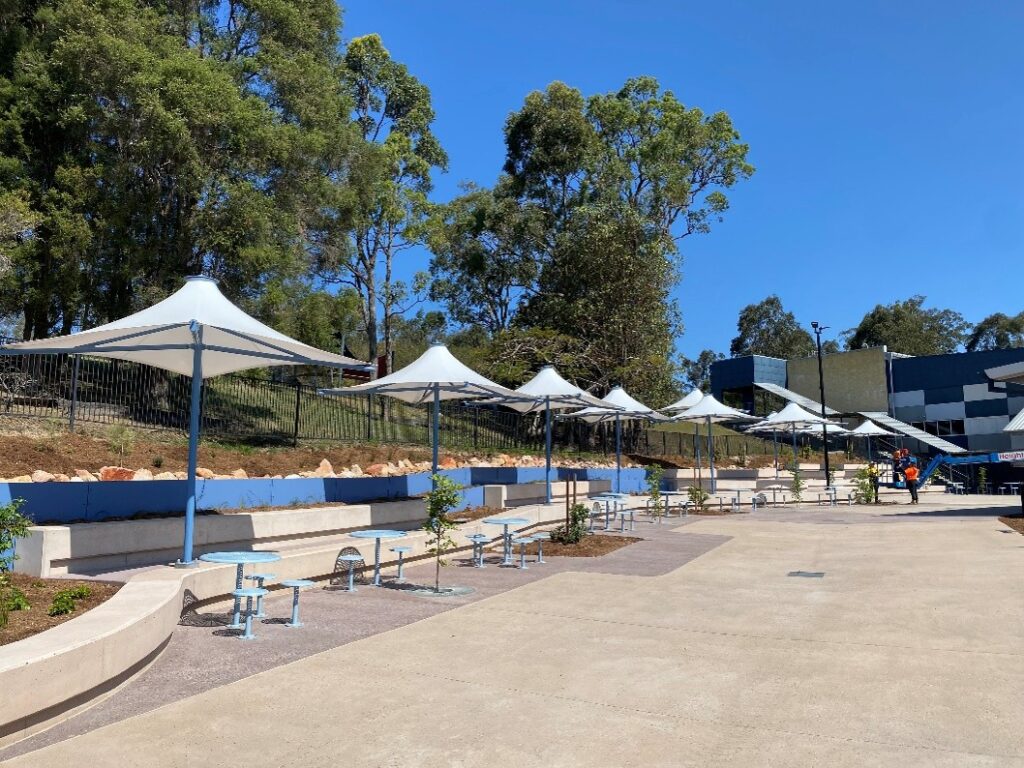
Protecting students from South-east Queensland’s intense solar ultraviolet radiation (UVR) requires an active approach to site planning and structural engineering. In educational environments, shade structures must do far more than offer relief from the heat. Facilities managers, school executives, and architects face strict compliance hurdles, complex safety mandates, and long-term durability requirements.
Designing purpose-built outdoor coverage involves navigating National Construction Code (NCC) standards, state safety guidelines, and material durability criteria to build long-lasting, safe learning spaces.
Navigating Queensland Compliance Standards for Educational Shade
Schools and early learning centres across Queensland operate under stringent infrastructure and safety guidelines. Every installed shade framework must meet local regulatory frameworks:
- National Construction Code (NCC) Building Code of Australia (BCA): Class 9b educational buildings require shade structures that satisfy specific structural safety, fire hazard indices, and wind loading standards.
- AS/NZS 1170 Structural Design Actions: Shade frames must be engineered for regional wind classifications (such as Region B for South-east Queensland), ensuring stability during severe storm activity.
- QLD Department of Education Design Standards: State school assets must feature compliant footings, non-climbable support columns, and minimum height clearances to prevent accidental impact or vandalism.
- Cancer Council Queensland Guidelines: Recommends shade structures that deliver a minimum of 94% to 99% UVR protection for maximum skin safety.
Comparative Material Analysis: PVC Waterproof Membranes vs. HDPE Shade Cloth
Selecting the correct fabric substrate dictates how well an outdoor space functions across different seasons. The primary choices are breathable High-Density Polyethylene (HDPE) shade cloth and waterproof Polyvinyl Chloride (PVC) architectural membranes.
| Feature / Criteria | HDPE Shade Mesh | Waterproof PVC Membrane |
| Primary Protection | High UVR blocking (up to 99%) | 100% UVR blocking + 100% rain protection |
| Airflow & Cooling | Highly permeable; lets trapped heat escape | Impermeable; requires higher apex or passive venting |
| Best Application | Playgrounds, sports ovals, sandpits | Outdoor learning areas, walkways, assembly zones |
| Acoustic Dampening | Low absorption | Moderate sound absorption for group activities |
| Maintenance Profile | Periodic tensioning and tension wash | Smooth, self-cleaning surface during rainfall |
| Expected Lifespan | 10 to 15 years | 15 to 20+ years |
Choosing between these options usually depends on functional goals. For general play areas where airflow is critical, breathable commercial shade sails keep ambient temperatures lower. For all-weather spaces, fully sealed heavy-duty waterproof shade systems turn open areas into functional outdoor classrooms.
Key Safety Design Considerations for Playgrounds and Early Learning Areas
Child safety requires strict design considerations to prevent injury during play. Architectural plans must address specific safety elements before fabrication:
[Non-Climbable Uprights] –> [Pad Protection to 1.8m] –> [Compliant Footings & Clearance]
1. Anti-Climbing Engineering
Children naturally climb structural elements. To prevent falls, support posts must feature smooth, non-climbable surfaces. Installers should avoid low-level horizontal bracing, footpegs, or exposed tensioning hardware below 2.4 metres.
2. High-Impact Protective Padding
For early learning centres and primary playgrounds, high-impact foam padding wrapped in heavy-duty commercial vinyl should encase all steel columns up to a height of at least 1.8 metres.
3. Clear Overhead Headroom
Structures over play equipment must maintain clear fall zones and vertical clearances. Shade covers must never encroach on playground fall-zone clearances defined under Australian Standard AS 4685.
Unlocking Outdoor Learning Classrooms
Incorporating compliant shade design directly expands a school’s usable teaching floor plate. Covered outdoor learning areas (COLAs) give educational institutions several functional benefits:
- Flexible Space: Transform bare concrete slabs into multipurpose assembly, drama, and sports hubs.
- Sensory Relief: Provide quiet, shaded refuge areas for sensory-sensitive students during high-heat break times.
- Asset Longevity: Shield expensive playground equipment, soft-fall rubber matting, and outdoor furniture from UV degradation.
Integrated architectural planning allows institutions to implement custom commercial shade structures tailored to match existing campus aesthetics and school colour palettes.
5 Frequently Asked Questions
1. What building approvals are required for installing a school shade structure in Queensland?
Most educational shade installations require a formal Development Application (DA) or a Code Assessment depending on local council planning overlays, land zoning, and proximity to boundaries. A certified private building certifier must approve the structural engineering drawings, footings, and wind-load calculations before site works commence.
2. How do we ensure shade sails placed over playgrounds meet non-climbability standards?
Non-climbability is achieved by maintaining smooth, vertical steel columns with no horizontal cross-members, turnbuckles, or low-level fixings below 2.4 metres. Additionally, shade edges must remain well out of reach of the highest play platform to prevent children from climbing from equipment onto the fabric.
3. What is the difference between shade mesh and waterproof fabric for school assemblies?
Shade mesh is knitted to allow air permeability, lowering ambient heat under the sail during hot days while blocking up to 99% of UV rays. Waterproof PVC or PVDF membranes create a complete weather barrier that channels rainwater away, allowing outdoor assemblies and classes to proceed uninterrupted during rain.
4. How often should school shade structures undergo safety inspections and maintenance?
School shade structures should be visually checked termly, with a comprehensive professional inspection conducted annually. Maintenance inspections evaluate thread integrity, fabric tensioning, steel corrosion, and the condition of footing connections to maintain structural integrity and safety standards.
5. Can custom school shade structures be designed to withstand cyclonic wind conditions in SEQ?
Yes. Structural engineers design shade frameworks specifically for the local wind region (such as Region B in South-east Queensland) according to AS/NZS 1170.2. Heavy-duty structural steel footings, hot-dip galvanised members, and high-tensile stainless steel fixings ensure the system withstands severe storms and extreme wind events.