
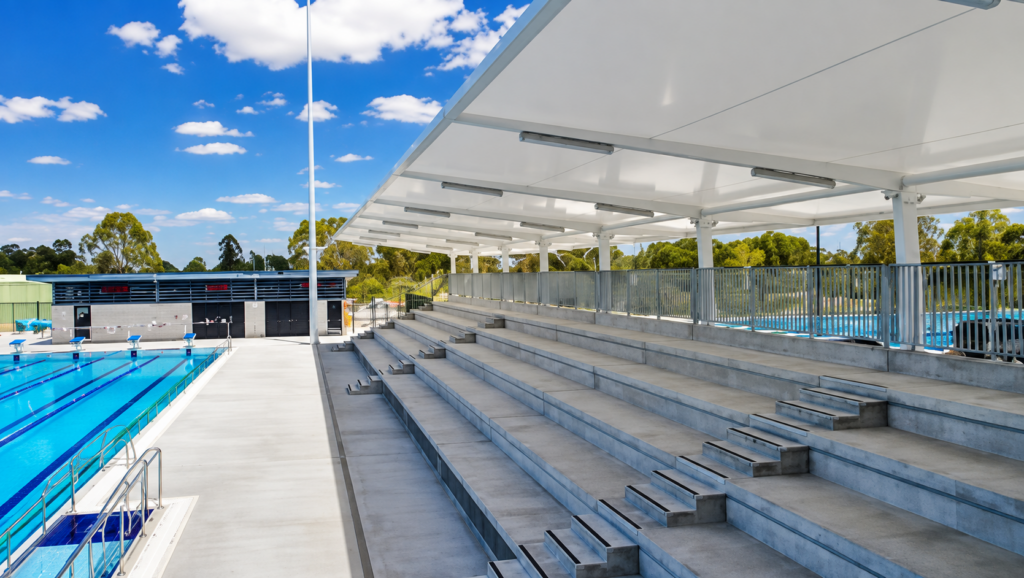
Selecting the ideal commercial cover for your facility is a critical design decision. The choice directly influences structural safety, user comfort, and long-term return on investment.
Queensland’s climate presents distinct weather extremes. Facilities face intense UV radiation, heavy rainfall, and severe coastal storms. Deciding between a water-resistant shade sail and a fully waterproof tension structure requires understanding how different architectural fabrics perform under stress.
This guide breaks down fabric engineering, performance metrics, and structural requirements. It will help you choose the right shade cover for your commercial project.
Understanding the Core Differences
The primary distinction between shade covers comes down to fabric weave and waterproof membrane technology.
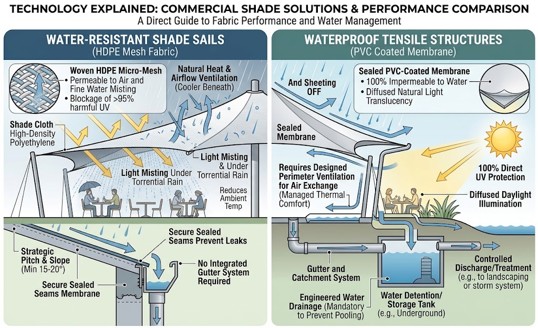
- Water-Resistant Shade Sails: Manufactured using knitted High-Density Polyethylene (HDPE) shade cloth. The material features micro-perforations that let air circulate while blocking up to 98% of harmful UV rays.
- Waterproof Tensile Structures: Built with solid architectural PVC membranes, PVDF coatings, or specialized coated HDPE fabrics. These materials create an impenetrable barrier against wind, rain, and debris.
Technical & Architectural Comparison
Below is a direct comparison of water-resistant shade sails and waterproof tensile structures across key performance metrics:
| Feature / Metric | Water-Resistant Shade Sails (HDPE Mesh) | Waterproof Tensile Structures (PVC / Coated Membrane) |
| Primary Function | Sun protection and micro-climate thermal cooling | Complete year-round weather protection (Sun & Rain) |
| Material Composition | Knitted High-Density Polyethylene | Architectural PVC, PVDF, or Vinyl-coated polyester |
| UV Protection Level | Blocks 90% to 98% of UV rays | Blocks 100% of direct UV rays |
| Water Performance | Rain-resistant; permits misting in heavy downpours | 100% waterproof with sealed seams |
| Airflow & Ventilation | High airflow reduces heat accumulation underneath | Requires planned perimeter ventilation or thermal design |
| Structural Steel Needs | Lower steel tonnage; simpler column footings | Higher structural steel requirements for tensioning |
| Required Roof Pitch | Minimum 10° to 15° slope | Minimum 15° to 20° slope to avoid water ponding |
| Typical Applications | School playgrounds, sports fields, retail precincts | Commercial carparks, walkways, outdoor dining |
Water-Resistant Shade Sails: Advantages & Use Cases
Water-resistant shade sails are ideal for applications where UV reduction and heat dissipation are top priorities.
Key Advantages
- Superior Thermal Comfort: Micro-perforated HDPE mesh lets trapped heat escape upward. This lowers ambient ground temperatures underneath by up to 10°C.
- Cost-Effective Coverage: Lighter fabric loads allow for longer spans, reduced steel frame weight, and smaller concrete foundations.
- Wind Resistance: Permeable weaves let strong wind gusts pass through the fabric. This reduces dynamic wind loads on columns during storms.
Best Commercial Applications
- School ovals and early learning play spaces.
- Public park amenities and recreational zones.
- High-wind coastal areas requiring sun protection.
- Community sports facilities and spectator seating.
To review design layouts for educational and public facilities, explore our custom Shade Sails services.
Waterproof Tensile Structures: Advantages & Use Cases
Waterproof tensile membrane structures turn open-air spaces into functional, all-weather commercial venues.
Key Advantages
- Total Rain Protection: High-frequency welded seams keep patrons, outdoor furniture, and equipment completely dry.
- Natural Light Translucency: Quality architectural PVC membranes allow diffuse natural daylight to pass through. This reduces artificial lighting costs during the day.
- Long-Term Durability: Advanced PVDF top-coatings resist grime, dirt, and pollution. They keep the surface clean with minimal maintenance.
Best Commercial Applications
- Car Park Shade Structures protecting multi-vehicle bays.
- Outdoor dining hubs for hotels, cafes, and club venues.
- Covered school walkways and main building entrances.
- Commercial loading docks and industrial workspace shelters.
For large-scale commercial protection, discover how custom-engineered Waterproof Shade Structures can transform your facility layout.
Essential Design & Engineering Factors
Installing a commercial shade solution requires detailed site assessment and strict adherence to Australian engineering standards.
- Pitch and Water Drainage: Waterproof structures must be designed with sufficient fall and tension. Incorrect pitch leads to water ponding, which can stretch fabric and cause structural failure.
- Wind Load Compliance: Structures must be engineered to withstand region-specific wind speeds. Engineered designs must comply with AS/NZS 1170.2 standards.
- Foundation Depth: Ground conditions across Queensland vary significantly. Soil condition dictates footings, anchor bolt specs, and steel reinforcement requirements.
- Council Approvals: Most commercial installations require certified building approvals and town planning reviews prior to construction.
If you are incorporating custom metalwork, integrated louvres, or perimeter shielding into your project, view our full range of custom Aluminium Screens and Sunhoods.
Frequently Asked Questions
Can a standard shade sail be retrofitted with waterproof fabric?
No, standard shade sail posts and footings are rarely suitable for waterproof fabrics. Waterproof membranes capture heavy rain and wind loads, generating significantly higher dynamic forces. Installing a waterproof fabric requires stronger structural steel framework and larger concrete footings to handle these loads safely.
How do you prevent water ponding on waterproof shade structures?
Water ponding is prevented through precise structural engineering, proper tensioning, and minimum slope angles. Designs must include a slope of at least 15 to 20 degrees, hyperbolic paraboloid (hypar) geometries, or curved barrel vaults. These shapes direct rainwater into integrated guttering systems quickly.
What is the typical lifespan of commercial shade fabrics?
Commercial-grade HDPE shade cloth typically lasts between 10 and 15 years. Premium architectural PVC tensile membranes can last 20 years or more with routine maintenance. Both material types feature multi-year commercial warranties covering UV degradation and structural failure.
Are shade sails suitable for high-wind storm zones in Queensland?
Yes, provided they are engineered to meet site-specific wind load standards. Permeable HDPE shade sails perform exceptionally well in high winds because their micro-weave permits air to pass through. For extreme weather events, high-tension systems can also be engineered with quick-release hardware for safe removal.
How do I choose between shade cloth and polycarbonate roofing?
Choose shade cloth when airflow, soft light diffusion, and broad-area UV protection are main priorities on a flexible budget. Choose solid roofing, such as specialized Polycarbonate Roofing, when your space requires complete rain cover with high structural rigidity and transparent natural light transmission.
{ “@context”: “https://schema.org”, “@type”: “FAQPage”, “mainEntity”: [{ “@type”: “Question”, “name”: “Can you convert an existing shade cloth structure into a waterproof sail?”, “acceptedAnswer”: { “@type”: “Answer”, “text”: “No. Waterproof fabrics incur significantly higher wind and water loads. Converting an existing structure usually causes structural failure because standard shade cloth posts and footings are not engineered to support waterproof membranes.” } },{ “@type”: “Question”, “name”: “What slope is required for a waterproof shade sail to prevent pooling?”, “acceptedAnswer”: { “@type”: “Answer”, “text”: “A minimum slope of 15 to 20 degrees is generally required for effective water runoff. Proper tensioning is equally critical to prevent the fabric from sagging and collecting water under heavy downpours.” } },{ “@type”: “Question”, “name”: “Which fabric lasts longer in harsh weather conditions?”, “acceptedAnswer”: { “@type”: “Answer”, “text”: “Both commercial-grade PVC membranes and architectural HDPE shade cloth feature long lifespans (often 10 to 15+ years). PVC membranes offer greater resistance to physical tearing and atmospheric debris, whereas HDPE shade cloth withstands high wind speeds with less structural stress.” } },{ “@type”: “Question”, “name”: “How do I maintain and clean a commercial shade structure?”, “acceptedAnswer”: { “@type”: “Answer”, “text”: “Clean your structures annually to remove leaf debris, dirt, and organic buildup. Wash PVC membranes using a mild detergent, warm water, and soft brushes or low-pressure hoses. Avoid harsh chemicals or high-pressure washers, which can damage protective coatings and fabric stitching.” } },{ “@type”: “Question”, “name”: “Are waterproof shade sails completely storm-proof?”, “acceptedAnswer”: { “@type”: “Answer”, “text”: “Commercial waterproof structures are engineered to satisfy Australian wind standards for specific regions, including cyclone-prone areas. However, severe weather events exceeding design parameters require inspections to verify tension, cable integrity, and footing stability.” } }] }Want full rain protection? Our waterproof shade sails page sets out the waterproof systems we build for commercial venues.