
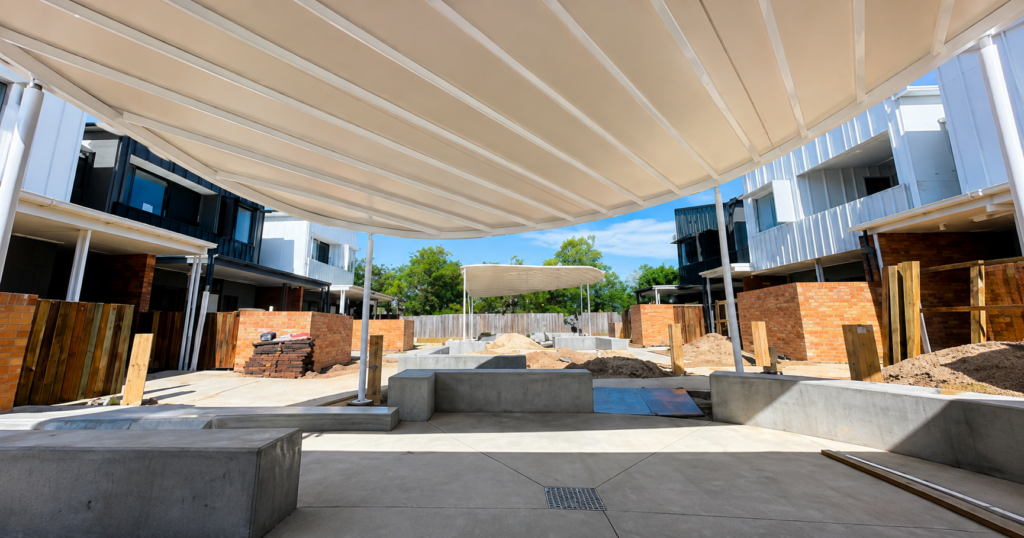
When procurement officers, commercial developers, and local councils invest in shade infrastructure, they aren’t just buying steel and fabric—they are investing in long-term asset protection, public safety, and financial risk mitigation.
In an increasingly globalised market, the temptation to opt for cheap, mass-produced imported shade structures can be strong. However, asset managers across Australia are uncovering the hidden costs of these offshore alternatives: premature material degradation, structural failures during severe weather events, compliance headaches, and non-existent post-installation support.
For commercial projects demanding longevity, choosing certified Australian Made shade infrastructure is no longer just a nod to supporting local industry; it is a critical strategy for risk management and engineering compliance.
Here is why local engineering and manufacturing matter when specifying commercial shade structures for Australia’s unforgiving climate.
1. Engineered for Extremes: Surviving the Australian Climate
The Australian continent experiences some of the most severe and volatile weather conditions on Earth. From the relentless, high-intensity UV radiation of the Sunshine Coast to the destructive cyclonic winds of Northern Australia and the sudden, heavy hail storms of South East Queensland, outdoor structures are constantly under stress.
Offshore, mass-produced shade systems are typically designed to generic, international baselines. They rarely account for the unique environmental degradation specific to Australia:
- The UV Factor: Australia’s UV index regularly hits extreme levels. Imported fabrics and low-grade PVC coatings that perform adequately in Europe or North America frequently chalk, crack, embrittle, and delaminate within a few short years under Australian sun exposure. Certified Australian Made structures utilise advanced, architectural-grade membranes (such as heavy-duty HDPE monofilament fabrics or premium PVC-coated polyesters) heavily stabilized against UV radiation.
- Corrosion Resistance: Coastal and sub-tropical environments introduce airborne salt and high humidity, which rapidly accelerate rust. Australian manufacturing standards ensure that structural steel undergoes rigorous hot-dip galvanising or advanced powder-coating processes designed to withstand these corrosive microclimates.
- Wind and Structural Loadings: A standard “off-the-shelf” imported shade sail or cantilever structure often lacks the structural engineering required to survive an Australian east coast low or severe thunderstorm. Locally fabricated structures are engineered from the ground up to satisfy the stringent requirements of AS/NZS 1170.2 (Structural Design Actions – Wind Actions), ensuring the steel thickness, weld penetration, and footings are robust enough to withstand localized wind loads.
Investing in locally fabricated infrastructure ensures that your asset remains standing, functional, and visually immaculate long after a cheaper alternative would require complete replacement.
2. Procurement Compliance, Certifications, and the National Construction Code (NCC)
Navigating the regulatory landscape of Australian commercial construction requires meticulous attention to compliance. Whether delivering a school assembly undercover area, a council park playground shelter, or a major retail car park installation, the legal liability rests entirely on the quality of the certified engineering.
Specifying an official Australian Made partner simplifies the entire compliance and tender process:
Strict Adherence to the Building Code of Australia (BCA)
Local manufacturers operate with an intimate, up-to-date knowledge of the National Construction Code (NCC). Every component—from the concrete footing depth to the tensile strength of the stainless-steel cables—is calculated to ensure full compliance. This eliminates the risk of private certifiers or local councils rejecting an installation due to unverified material tracking or non-compliant engineering drawings.
Material Traceability and Weld Compliance
In Australia, structural steel fabrication is governed by strict quality standards, including AS/NZS 5131 (Structural steelwork – Fabrication and erection). When you work with a certified domestic manufacturer, you receive full material traceability. You can verify that the steel used is premium grade, the welders hold valid Australian certifications, and the welds have undergone non-destructive testing where required. Imported alternatives frequently arrive with unverified material certificates, leaving principal contractors highly vulnerable to structural liability.
Streamlining Government and Corporate Tenders
Local, state, and federal government bodies increasingly mandate or heavily weight “Local Content” requirements within their procurement policies. Choosing an Australian Made certified partner ticks a critical compliance box for ethical procurement, supporting regional economies while guaranteeing that public funds are spent on reliable, safe infrastructure.
3. Supply Chain Reliability and Project Timelines
In commercial construction, delays cost money. Managing a multi-stage commercial development or council civil works project requires tight orchestration of subcontractors, trades, and material deliveries.
Realistic project timelines are frequently derailed when relying on imported infrastructure:
- The Shipping Bottleneck: International freight remains unpredictable. Port congestion, customs delays, and global supply chain disruptions can turn a standard 8-week lead time for an imported structure into a 6-month logistical nightmare, delaying project handovers and incurring liquidated damages.
- Agile Customization: No two commercial sites are identical. Sloping ground conditions, underground services, and architectural setbacks often require sudden, on-site modifications or rapid turnarounds on custom steel adjustments. A domestic manufacturer can pivot instantly, modifying shop drawings and fabricating adjusted components in days. Conversely, if an imported pre-fabricated structure arrives on-site and doesn’t fit due to a minor site variance, the project grinds to a halt while replacement parts are shipped from overseas.
- Seamless Trade Coordination: Local manufacturers fabricate to order and coordinate deliveries directly with on-site project managers. This ensures heavy steel frames and tension membranes arrive precisely when the site is ready for installation, reducing the need for costly on-site material storage and minimizing double-handling.
4. Total Cost of Ownership vs. Initial Purchase Price
While a cheap imported shade structure may look attractive on an initial line-item quote, a true life-cycle cost analysis reveals it is often a false economy.
| TRUE COST OF SHADE INFRASTRUCTURE | |
| Imported / Mass-Produced | Certified Australian Made |
| ❌ Low Initial Cost | ⚡ Higher Initial Quality |
| ❌ Frequent Fabric Failures | ⚡ 15+ Year Asset Lifespan |
| ❌ Structural Corrosion | ⚡ Cyclone & UV Compliant |
| ❌ No Local Warranty Asset | ⚡ Full Material Traceability |
| ⚠️ High Life-Cycle Cost | ✅ Low Total Cost of Own. |
When evaluating the financial blueprint of your infrastructure project, consider the long-term operational impacts:
- Lifespan Multipliers: A premium, Australian-fabricated tension membrane structure or polycarbonate roofing system can easily achieve a operational lifespan of 15 to 20+ years with basic maintenance. A low-grade import frequently requires structural remediation or complete fabric replacement within 3 to 5 years due to stitching failures, tension loss, or steel corrosion.
- Maintenance and Asset Presentation: Commercial properties rely on clean, modern, and high-end aesthetics to attract customers and tenants. Faded, sagging, or rust-stained shade sails drastically degrade the curb appeal and perceived value of a commercial precinct. Australian-made systems utilize heavy-duty, self-cleaning PVC coatings and premium structural finishes that resist mould, atmospheric dirt accumulation, and staining.
- Real, Actionable Warranties: A warranty is only as good as the company backing it. If an imported structure fails structurally or suffers severe material degradation, chasing an overseas manufacturer for rectification is practically impossible. Partnering with an established local manufacturer means your investment is protected by enforceable Australian Consumer Law, backed by a local team that can be on-site within 48 hours to assess, repair, or service the structure.
The Verdict: Protecting People and Capital
Specifying commercial shade infrastructure is an exercise in risk management, structural engineering authority, and long-term financial foresight.
By choosing certified Australian Made shade structures, commercial developers, architects, and public sector procurement officers secure an asset that is precision-engineered for our local environment, fully compliant with national building standards, and delivered via a reliable, transparent supply chain.
When you build for Australian conditions, building in Australia remains the ultimate blueprint for success.
.cstseotable{ font-weight: 400 !important; } .cstseotable td { padding: .2em .5em !important; } .cstseotable{ font-family: Lato, sans-serif !important;}